- All
- Product Name
- Product Keyword
- Product Model
- Product Summary
- Product Description
- Multi Field Search
Please Choose Your Language

Views: 0 Author: Site Editor Publish Time: 2026-07-24 Origin: Site


Selecting the optimal jump rope requires matching the tool's physical properties to your specific biomechanical needs and cardiovascular targets. Jumping rope offers exceptional cardiovascular efficiency and lower-body conditioning, but equipment mismatch remains the primary cause of early abandonment, frequent tripping, and joint strain. When individuals use a rope unsuited for their mechanics, they compromise their form and fail to achieve the desired training stimulus.
The fitness market is saturated with variations in cable weight, handle mechanics, and construction materials. Consumers frequently purchase the wrong tool for their current skill level. For example, beginners often buy advanced speed ropes, leading to a complete lack of tactile feedback and poor jumping form. Without feeling the rope's position in space, timing the jump becomes frustrating and inefficient.
To solve this, you need a structured evaluation framework. By aligning specifications—such as material density, cable weight, dynamic sizing, and handle mechanics—with specific fitness outcomes and training environments, you can select equipment that actively enhances your performance rather than hindering it.
Skill Dictates Weight: Heavier, thicker cables provide necessary tactile feedback for beginners, while ultra-thin steel cables are strictly for advanced speed and double-unders.
Sizing is Dynamic: The baseline sizing rule (height plus 3 feet) is a starting point; optimal length decreases as jumper proficiency and rotational efficiency increase.
Goal Alignment: Treat the jump rope as specialized strength training equipment or a cardio tool depending on the cable resistance and handle design chosen.
Surface Compatibility: Cable lifespan is heavily dependent on the jumping surface; outdoor concrete requires PVC or coated cables, while bare steel is reserved for rubberized gym mats.
Jumping rope delivers high-yield athletic benefits that extend far beyond basic calorie burning. The repetitive bounding motion improves bone density through controlled, low-level impact. It builds lower-body elasticity, specifically targeting the Achilles tendon and the entire calf complex. This elasticity translates directly to improved running economy and agility. Furthermore, it provides rapid metabolic conditioning, elevating the heart rate efficiently within a minimal footprint.
When integrated with heavy lifting, a jump rope serves as a highly effective warm-up or active recovery tool. Using it alongside heavy strength training equipment primes the central nervous system for explosive movements. It increases core temperature and promotes blood flow to the extremities without causing excessive muscle hypertrophy or joint shearing. The minimal eccentric loading means you can recover quickly, making it ideal for between-set conditioning.
Compared to bulky treadmills or stationary bikes, this tool stands out among standard fitness accessories. Its portable, low-space nature makes it an indispensable asset for home gyms, outdoor workouts, and travel. You can achieve a maximal aerobic output in a fraction of the space required by traditional cardio machines.
Bone Mineral Density: The repeated sub-maximal impacts stimulate osteoblast activity in the lower extremities.
Fascial Elasticity: The bounding motion trains the fascia to store and release kinetic energy efficiently.
Neuromuscular Coordination: Synchronizing upper body rotation with lower body bounding forces the brain to map complex motor patterns.
Metabolic Output: Sustained jumping can burn up to 15-20 calories per minute depending on the intensity and cable weight.
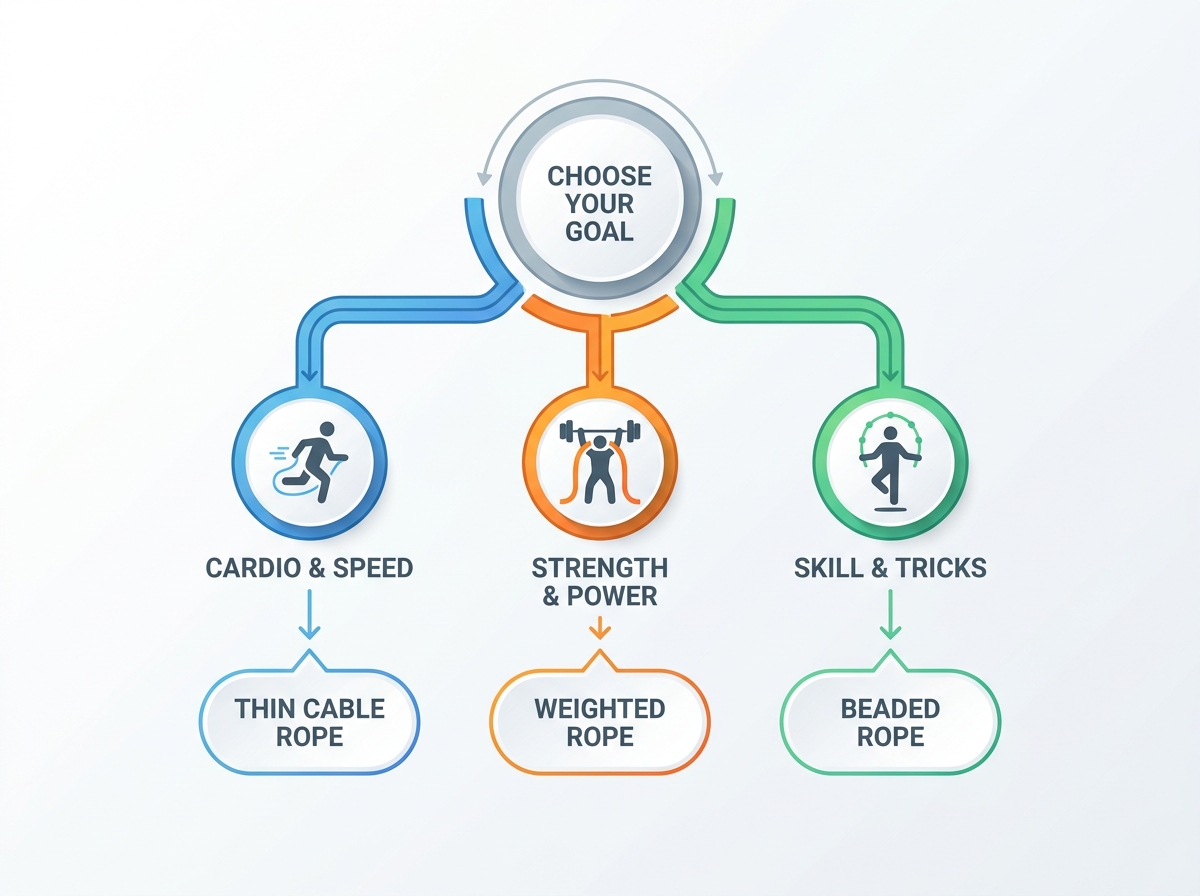
Before evaluating materials, you must identify your core workout objective. Different goals require fundamentally different rope physics. Aerobic conditioning benefits from a steady, sustainable rhythm. Muscular endurance demands heavier resistance. Agility training and freestyle tricks require distinct aerodynamic profiles to allow for manipulation of the cable's arc.
Assessing your current skill level and biomechanics is equally critical. Proprioception—the body's ability to sense movement and position—plays a massive role in jumping. Beginners need to feel the rope's rotation around their body to time their jumps accurately. A heavier cable provides this centrifugal feedback. Advanced users, having developed this timing, rely on wrist efficiency and minimal aerodynamic drag to achieve high rotational speeds.
Consider how the rope integrates with your existing regimens. If your routine heavily features upper-body burnout sessions, a weighted cable complements that goal. Conversely, if you are performing high-intensity interval training or CrossFit workouts, a lightweight speed rope is necessary to minimize shoulder fatigue and maximize revolutions per minute.
Finally, the training environment dictates durability requirements. Individual training allows for highly specialized, delicate equipment. Group fitness or physical education programs demand extreme durability, quick adjustability, and mass-market versatility to accommodate varying heights and skill levels on abrasive surfaces.
Fitness Goal | Recommended Cable Type | Primary Benefit | Skill Level Required |
|---|---|---|---|
General Cardio & Timing | 5mm PVC / Licorice | Balanced feedback and moderate speed | Beginner to Intermediate |
Double-Unders & HIIT | Bare Steel / Coated Wire | Maximum RPM and minimal drag | Advanced |
Muscular Endurance | Weighted Cable (1/4 lb - 2 lbs) | Upper body engagement and high calorie burn | Intermediate to Advanced |
Freestyle & Tricks | Beaded Rope | Maintains shape at slow speeds, audible feedback | All Levels |
Solid PVC ropes offer a medium weight and moderate aerodynamic drag. They provide a balanced rotation that is neither too fast nor too slow. This makes them ideal for general fitness, beginner timing development, and outdoor durability. The thicker plastic resists abrasion well on rough surfaces. However, PVC can warp or become stiff in extreme cold temperatures, and the inherent drag limits the maximum rotation speed for advanced agility work.
Constructed from bare or thinly coated aircraft-grade steel, speed ropes are designed for minimal air resistance. They cut through the air rapidly, making them the standard for double-unders, competitive skipping, and high-intensity interval training. The trade-off is significant: a missed jump with a steel cable is painful, often leaving whip marks. Furthermore, the lack of weight provides zero tactile feedback, making them highly unsuitable for beginners trying to learn timing.
Weighted ropes feature cables weighing anywhere from 1/4 lb to over 2 lbs. This design shifts the physiological focus from pure speed to muscular endurance. They are excellent for integrating into strength routines, maximizing caloric expenditure, and building shoulder and forearm stability. The primary drawback is a high fatigue rate. Using heavy cables requires strict, disciplined form to prevent rotator cuff irritation or wrist strain as fatigue sets in.
Beaded ropes consist of a nylon cord encased in segmented plastic beads. This construction creates an audible "tick" upon striking the ground and holds a consistent, wide U-shape arc during rotation. They are the preferred tool for freestyle tricks, rhythmic gymnastics, and developing spatial awareness indoors. The heavy aerodynamic drag caused by the beads makes them inefficient for high-speed workouts or prolonged cardiovascular sessions.
Ropeless systems utilize standard handles attached to short, weighted lanyards that simulate rotational momentum without a full cable clearing the body. They are designed for extreme spatial constraints, such as low ceilings or small apartments. They also serve individuals undergoing injury rehabilitation or those with severe tripping hazards. While they elevate the heart rate, they completely remove the coordination, timing, and spatial awareness benefits of clearing an actual cable.
Industry experts frequently disagree on the best starting point for novices. Some advocate for ultra-light PVC to reduce fatigue, while others push heavy ropes to force proper form. The most effective recommendation lies in the middle. A lightly weighted cable, typically between 1/4 lb and 1/2 lb, provides the sweet spot. It offers enough centrifugal feedback to help the user feel the rope and prevent tripping, without causing the premature shoulder fatigue associated with heavier 1 lb or 2 lb cables.
The rotation mechanism inside the handle dictates the smoothness of the workout. Dual-ball bearing systems offer frictionless rotation, allowing the cable to turn independently of the handle. This significantly reduces wrist fatigue and prevents the cable from tangling or coiling during high-RPM workouts. Standard plastic bushings, while simpler and highly durable, generate more friction, which can slow down the rotation and increase the effort required from the wrists.
A critical distinction exists between weighted handles and weighted cables. Weighted handles primarily fatigue the grip and forearms, offering minimal full-body benefit. Weighted cables, however, create centrifugal force as they rotate, engaging the shoulders, core, and back to stabilize the movement. For true strength and conditioning benefits, prioritize weighted cables over heavy handles.
Handle ergonomics directly impact workout duration. Foam grips are comfortable but absorb sweat, leading to odor and degradation over time. Knurled aluminum handles offer extreme durability and excellent grip security, but they can feel cold and heavy. Rubberized plastic or silicone grips provide a balanced solution, offering a secure hold while remaining easy to clean and maintain.
Proper sizing is non-negotiable for maintaining upright posture. The industry standard baseline measurement requires standing on the middle of the rope; the base of the handles should reach your armpits. Mathematically, the maximum starting length of the rope (including handles) should be your height plus exactly 3 feet. For example, a 5'8" jumper requires a maximum rope length of 8'8". This formula provides enough clearance over the head and under the feet for a standard, upright bounding posture without forcing the jumper to tuck their knees.
Jumper Height | Baseline Rope Length (Height + 3ft) | Advanced Rope Length (Height + 2ft) |
|---|---|---|
5'0" | 8'0" | 7'0" |
5'4" | 8'4" | 7'4" |
5'8" | 8'8" | 7'8" |
6'0" | 9'0" | 8'0" |
6'4" | 9'4" | 8'4" |
Sizing is not static. As jumpers gain proficiency, they naturally tighten their rotational arc to reduce drag and increase speed. Advanced users progressively shorten their ropes to their height plus 2 to 2.5 feet. If a rope is too long, form indicators will appear: the jumper will kick their feet backward (donkey kick) or widen their arms out of the optimal "pockets" near the hips to take up the slack.
Fixed-length custom ropes offer maximum longevity as there are no moving parts to break. However, adjustable ropes—utilizing set screws or wire cutters—allow for the necessary micro-adjustments as your form improves. When using adjustable cables, ensure the set screws are tightened securely before every session, as the vibration from high-speed workouts can cause them to loosen, resulting in the cable flying out of the handle.
The jumping surface dictates the lifespan of your equipment. Bare steel cables will fray, splinter, and snap rapidly when used on abrasive concrete or asphalt. For outdoor use, solid PVC or heavy-duty coated cables are mandatory. To mitigate wear and tear entirely, utilize a dedicated rubber jump rope mat. This extends the life of the cable and reduces the impact forces transmitted through the lower leg joints.
A frequent implementation risk is beginners purchasing elite speed ropes simply because they look professional or are marketed heavily in functional fitness spaces. This results in constant tripping and frustration due to a complete lack of spatial feedback from the ultra-thin cable. Mitigate this by starting with a 1/4 lb to 1/2 lb weighted rope or a standard 5mm PVC rope to build neuromuscular timing before ever transitioning to bare steel.
Compensating for a rope that is too long forces the jumper to flare their elbows outward away from the ribs. This leads to rapid shoulder fatigue, inefficient rotation, and an inability to string together multiple jumps. Regularly audit your rope length. Record a video of your jumping form from the front to ensure your hands remain close to your hip bones and your elbows stay tucked backward.
Measure your exact height in your standard training shoes and cut your cable to the baseline length of height plus three feet.
Evaluate your primary training surface and purchase a rubber mat if you plan to jump on concrete or asphalt.
Record a 30-second video of your jumping form to verify your hands remain at hip level and your elbows stay tucked.
Upgrade to a dual-bearing handle system once you can consistently string together 100 unbroken single unders.
A: Beginners should focus on lightly weighted cables (1/4 lb to 1/2 lb) or solid PVC ropes. These materials provide essential tactile feedback and centrifugal force, allowing the user to feel the rope's position in space and develop proper timing without premature shoulder fatigue.
A: Apply the standard height plus 3 feet rule for your baseline measurement. For a height of 5'8", the maximum starting length of the rope, including the handles, should be exactly 8'8". You can shorten it as your form improves.
A: It depends on the goal. Weighted ropes are superior for building upper-body muscular endurance, increasing caloric burn, and providing feedback for beginners. However, they are inferior for high-speed agility work, double-unders, or prolonged cardiovascular sessions where minimizing fatigue is the priority.
A: No. Bare steel or thinly coated speed ropes will quickly fray, splinter, and snap when repeatedly striking abrasive surfaces like concrete or asphalt. For outdoor use, you must use a thick PVC rope, a heavily coated cable, or a dedicated rubber jump mat.
A: Weighted cables create centrifugal resistance as they rotate, requiring the entire upper body (shoulders, back, core) to stabilize the movement. Weighted handles only tax the grip and forearms, offering significantly fewer full-body strength and conditioning benefits.
A: Ropeless systems effectively elevate the heart rate and provide a cardiovascular workout, especially in confined spaces. However, they completely eliminate the need for timing, spatial awareness, and coordination, which are primary neurological benefits of clearing an actual rotating cable.
