- All
- Product Name
- Product Keyword
- Product Model
- Product Summary
- Product Description
- Multi Field Search
Please Choose Your Language

Views: 0 Author: Site Editor Publish Time: 2026-07-25 Origin: Site


Selecting the right conditioning gear often comes down to understanding the exact physical limitations of the materials you use. Athletes frequently experience the frustration of cables snapping mid-workout on concrete, deal with annoying kinks that disrupt double-unders, or suffer painful welts from missed jumps. These failures rarely stem from poor technique. They are usually the direct result of mismatched cable materials.
Choosing a high-performance jump rope requires looking far beyond handle ergonomics. The core cable material dictates rotational physics, aerodynamic drag, tactile feedback, material memory, and the ultimate lifespan of the equipment across different training surfaces. A cable optimized for indoor wooden floors will shred in minutes on rough asphalt. A heavy outdoor cord will exhaust your shoulders during speed work.
To maximize your conditioning efforts, you must evaluate the technical properties of common cable materials. Understanding these differences helps you match the right gear to your specific training environments, fitness goals, and current skill levels.
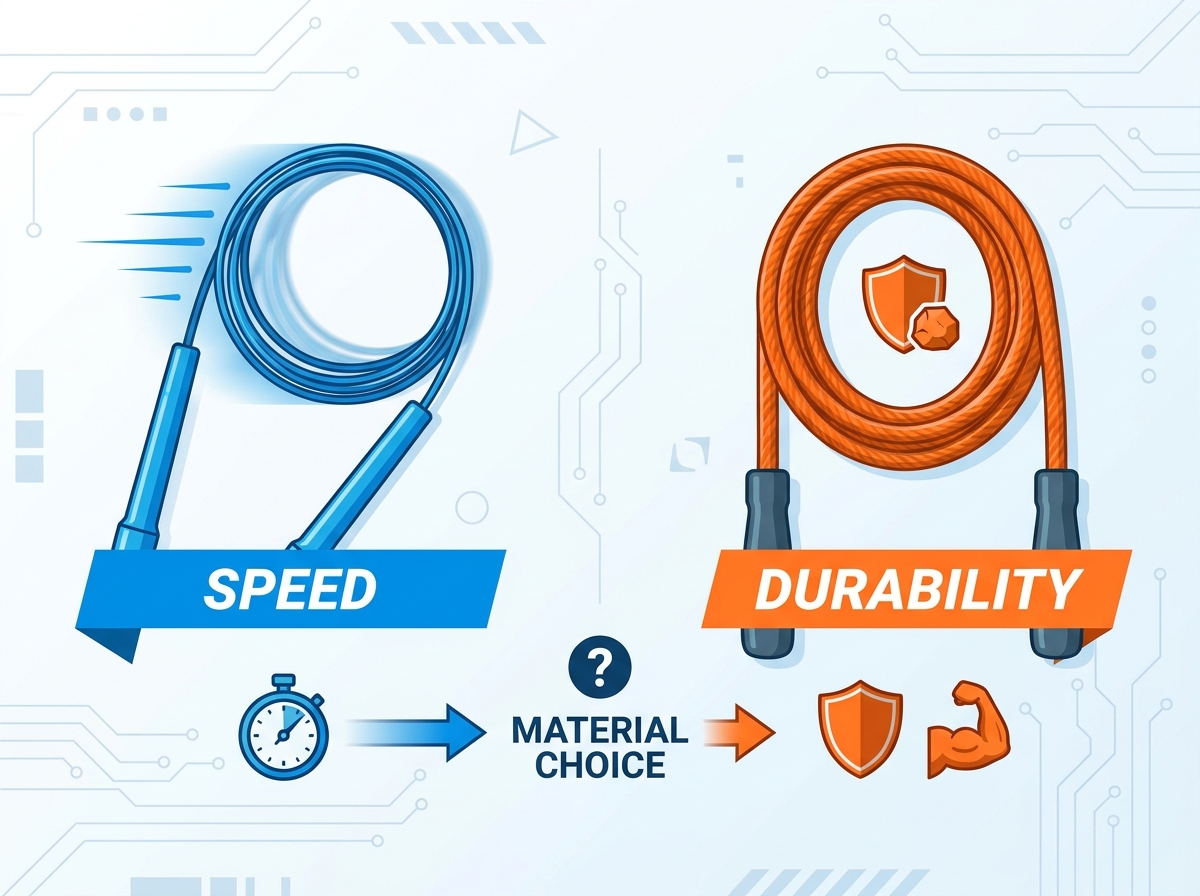
Speed vs. Drag: Bare steel cables offer the highest rotational velocity and lowest air resistance, making them the gold standard for advanced speed work and indoor competitive use.
Durability Trade-offs: Nylon and PVC coatings protect steel cores from abrasive fraying but introduce varying degrees of aerodynamic drag and surface friction.
Environmental Constraints & The "Strike Zone": Operating any standard cable or PVC rope on high-abrasion surfaces (concrete, asphalt) accelerates degradation exponentially at the central point of impact; surface matching is non-negotiable for longevity.
Trick & Transition Viability: Ultra-light speed cables collapse during off-axis movements like side swings and criss-crosses. Heavy solid PVC and beaded ropes maintain their arc, making them superior for freestyle conditioning.
Skill-Level Matching: Heavier, denser materials (like solid PVC) provide necessary proprioceptive feedback for beginners to master timing, whereas ultra-thin cables require advanced coordination to prevent painful missteps.
Cable diameter and material density directly impact air resistance and rotational velocity. A thin 2mm bare wire cuts through the air with minimal drag. This allows for rapid acceleration with very little wrist effort. A thicker 5mm cord pushes more air out of the way. This creates drag that requires more muscular force to maintain speed. Reducing aerodynamic drag limits shoulder fatigue during high-volume sets. This mechanical advantage is why competitive athletes prefer thinner cables for timed events.
Cable weight also dictates spatial awareness, often referred to as proprioception. Materials that are too light provide very little tactile feedback. Beginners often lose track of the rope's apex when using lightweight cables. This leads to premature trips and broken rhythms. Heavier materials generate enough centrifugal force to let the user feel exactly where the cable is during its rotation. You need that feedback to build muscle memory.
Centrifugal force affects how well a material maintains its shape. Rigid materials hold a consistent arc during rotation. Softer or lighter materials tend to stretch, warp, or collapse entirely at high speeds. This structural collapse makes off-axis tricks nearly impossible with ultra-light gear. You cannot perform a proper side swing if the cable loses its tension mid-air.
Material memory refers to a cable's tendency to retain the shape it was stored in. Low-quality PVC and thin, uncoated cables often hold loops and kinks from being coiled in a gym bag. These kinks create frustrating tangles that disrupt rotational alignment. They cause the cable to bounce unpredictably off the floor. High-quality nylon coatings and beaded cords resist this memory. They remain straight and kink-free immediately upon uncoiling.
Material Type | Aerodynamic Drag | Tactile Feedback | Material Memory Risk | Ideal Use Case |
|---|---|---|---|---|
Bare Steel Wire (2mm) | Very Low | Low | High (if bent sharply) | Indoor Speed / Competition |
Nylon-Coated Steel (3mm) | Low | Medium | Low | Mixed Indoor/Outdoor Speed |
Solid PVC (5mm) | Medium | High | Medium | Freestyle / Beginners |
Beaded Rope | High | Very High | None | Tricks / Rough Surfaces |
Bare steel wire delivers unmatched RPM capabilities. It is the absolute standard for double and triple-unders. Without a protective coating, the wire slices through the air with zero friction. However, this speed comes with a strict pain penalty. Missed jumps result in sharp, painful skin welts. You must maintain extreme focus and precision when using bare wire.
Initial setup for bare steel cables is highly rigid. You cannot simply tie a knot in them. They require dedicated wire cutters for sizing. They are secured via adjustable thumbscrews or fixed crimp collars. Once cut, adjustments are limited. Bare steel has a high rate of fraying and snapping if used on hard surfaces. It is completely unsuitable for outdoor use. You must restrict it to rubber mats or smooth indoor flooring.
Measure the cable by standing on the center and pulling the handles to your armpits.
Mark the exact cutting point with a marker.
Use heavy-duty wire cutters to cleanly sever the braided steel.
Cap the exposed end immediately to prevent the wire from fraying.
Secure the set screws tightly and test the rotation before full use.
Coated steel cables attempt to balance speed with protection. Nylon coatings offer a premium balance. Nylon is stiffer, faster, and significantly more durable against abrasion than PVC. It resists retaining storage kinks and slides smoothly over gym floors. It does come at a higher cost, but the longevity justifies the investment for serious athletes.
PVC coatings represent the economical standard. PVC is highly flexible and carries a lower price point. It wears down much faster on rough surfaces compared to nylon. PVC also tends to stretch slightly under high centrifugal force. It creates more aerodynamic drag, slowing down the maximum potential rotational speed. If you train exclusively indoors, PVC is adequate, but it falls short for rigorous outdoor conditioning.
Solid 4mm to 5mm PVC ropes are excellent for freestyle jumping, side swings, and foundational cardio. The material carries enough weight to provide great feedback. It allows for easy knot-based sizing directly inside the handle. Solid PVC resists permanent kinking better than thin wire cables. You can easily adjust the length on the fly without tools.
Durability depends heavily on the environment. While it handles smooth surfaces well, solid PVC is highly susceptible to snapping in freezing temperatures. The polymer crystallization that occurs in the cold makes the plastic brittle. It will shatter upon impact with the frozen ground. Keep PVC ropes indoors during the winter months.
Leather holds a strong historical association with boxing and old-school conditioning. Modern athletes largely reject it. Leather suffers from inconsistent weight distribution. It stretches significantly over time. It absorbs moisture from sweat and humid environments. This alters its weight dynamically during a workout. The organic nature of the material results in slow rotational speeds. It has a tendency to rot if not properly maintained and oiled.
Cloth and woven ropes generate massive aerodynamic drag. They retain heavy amounts of moisture. They lack the mass required to build rotational momentum. You have to force the rope over your head with excessive arm movement. These materials should be positioned strictly for low-impact, slow-paced warm-ups. Athletes looking for reliable strength training equipment should avoid cloth ropes entirely. They do not provide the mechanical efficiency needed for high-intensity interval training.
Beaded ropes feature shatterproof plastic beads threaded over a braided nylon cord. This design provides maximum durability on raw concrete. It delivers excellent tactile feedback. The segmented design prevents kinking entirely. You trade off top-end speed, but you gain unparalleled control for trick execution. They are perfect for side swings and reliable performance in cold weather. The beads take the abrasive damage, protecting the inner cord completely.
Training on concrete or asphalt introduces the strike zone phenomenon. This is the concentrated point of impact where the cable repeatedly strikes the ground. High friction strips protective coatings instantly. It exposes core materials to moisture and rapid wear. Bare steel and thin PVC coatings will fail within a single session on these surfaces. The friction generates heat and physical abrasion that tears through thin polymers.
To mitigate this rapid degradation, you must use heavy-duty outdoor cables or beaded ropes. Alternatively, the mandatory use of a dedicated rubber mat will protect your fitness accessories from the harsh ground. A mat extends the lifespan of any cable material indefinitely by providing a smooth, energy-absorbing strike zone.
Smooth, energy-absorbing surfaces allow almost all materials to achieve their maximum intended lifespan. Bare steel, thin PVC, and nylon-coated cables thrive on rubber gym mats and hardwood floors. The lack of surface friction preserves the integrity of the cable. You can focus entirely on technique rather than equipment preservation. Hardwood floors offer the best rebound for the cable, maintaining rotational speed effortlessly.
Environmental factors play a massive role in equipment longevity. UV exposure and freezing temperatures cause polymers like PVC to become brittle. They will crack and snap mid-rotation. If you train in unheated garages or outdoors in the winter, nylon-coated and steel-core cables are required. They retain their structural integrity across shifting climates. Store your gear in a temperature-controlled environment to prevent premature material failure.
Beginners need to feel the rope to understand timing. Solid 5mm PVC or beaded ropes provide the necessary physical feedback for skill development. The heavier weight slows the rotation down just enough to allow the brain to process the rhythm. This entirely avoids the speed and pain penalties associated with bare steel wires. You must master the basic bound before attempting high-speed rotations.
Competitive fitness demands maximum efficiency. Thin nylon-coated or bare steel cables reduce forearm fatigue. They allow athletes to execute seamless double-unders during high-intensity training. The low drag ensures that the cardiovascular system is taxed before the local muscles in the shoulders and wrists give out. Efficiency is the primary metric for competitive conditioning.
Freestyle training involves off-axis movements and complex transitions. Heavy PVC and beaded ropes are required to maintain cord tension during these movements. If you attempt a side swing with an ultra-light speed cable, the rope will collapse mid-air. This ruins the transition and stops the workout. You need mass to keep the arc wide and stable.
Thick, weighted PVC or braided steel cables serve as standalone conditioning tools for upper body endurance and grip strength. Using weighted materials shifts the physical load away from pure cardiovascular output. It places heavy demands on the muscular system. This specifically targets the lats, shoulders, and forearms. Heavy ropes force you to maintain a rigid core and strong wrist stability throughout the entire set.
Evaluate your primary training surface immediately to rule out incompatible materials like bare steel on concrete.
Assess your current skill level and select a heavier PVC rope if you are still mastering basic timing and coordination.
Inspect the handle bearing systems on your prospective gear to ensure they match the rotational demands of your chosen cable.
Purchase a dedicated rubber mat if you plan to train outdoors to protect your cable from rapid abrasive wear.
A: No. Bare steel will fray and snap very quickly when exposed to the high friction of concrete or asphalt. It should only be used on smooth indoor surfaces or dedicated rubber mats.
A: Low-quality or very thin PVC has high material memory. It retains the coiled shape from your gym bag. Upgrading to a thicker solid PVC or a nylon-coated cable will reduce kinking.
A: Leather is not recommended for beginners. It stretches, absorbs sweat, and rotates slowly. This makes it difficult to establish a consistent rhythm compared to solid PVC or beaded ropes.
A: Bare steel or thin nylon-coated steel cables are best for double-unders. They offer the lowest aerodynamic drag, allowing for rapid wrist rotation with minimal shoulder fatigue.
A: No. Beaded ropes are highly durable. The shatterproof plastic beads take the brunt of the impact against the ground, protecting the inner cord and making them ideal for rough surfaces.
A: Cold temperatures cause PVC and other basic plastics to crystallize and become brittle. This increases the risk of the cable snapping. Nylon-coated or bare steel cables perform much better in freezing conditions.
