- All
- Product Name
- Product Keyword
- Product Model
- Product Summary
- Product Description
- Multi Field Search
Please Choose Your Language

Views: 0 Author: Site Editor Publish Time: 2026-07-29 Origin: Site


The increasing demand for portable, at-home fitness solutions has positioned the portable pilate bar as a primary alternative to bulky, expensive reformer machines and traditional gym setups. Consumers struggle to determine if a lightweight bar equipped with resistance tubes and exercise bands can genuinely stimulate muscle growth, provide adequate tension, and support a comprehensive full-body workout compared to free weights. This guide breaks down the specific biomechanics of a pilate bar, mapping out exact muscle engagement across the upper body, lower body, and core, while providing a framework to evaluate if this equipment meets your specific training requirements. We analyze the mechanics of variable resistance, detail specific exercises for each muscle group, and outline the practical realities of using this equipment daily to ensure you maximize your training efficiency.
Comprehensive Muscle Targeting: A pilate bar effectively engages the posterior chain (glutes, hamstrings), core stabilizers, and upper body (shoulders, back) through variable resistance.
Variable Resistance Mechanics: Unlike static free weights, the reliance on resistance tubes creates continuous time under tension, altering how muscles fatigue and adapt.
Simultaneous Multi-Muscle Engagement: By combining a rigid bar with exercise bands, users can perform compound, full-body movements that recruit stabilizer muscles and mimic both reformer and ballet barre dynamics.
Scalability Limits: While excellent for endurance, mobility, and foundational strength, users must evaluate the maximum tension limits of the exercise bands for long-term progressive overload.
Implementation Reality: Proper form, tension adjustment, and equipment durability (specifically the connection points between the bar and tubes) are critical to mitigating injury risks and ensuring consistent workout quality.
The tension in resistance tubes increases as they stretch, requiring peak muscle contraction at the end of the range of motion. This variable resistance profile ensures that your muscles work harder precisely when they are fully contracted. It forces continuous engagement throughout the movement, preventing the resting phases common with traditional momentum-based lifting. When you push or pull against the bands, the resistance curve matches the natural strength curve of your muscles. This means the exercise gets harder as your mechanical advantage improves. You cannot rely on momentum to complete a repetition. Every inch of the movement requires active muscle fiber recruitment. This constant demand forces the nervous system to adapt, improving overall muscle coordination and motor unit recruitment. The elastic properties of the tubes also mean that the eccentric phase of the lift requires just as much control as the concentric phase. If you simply let the bands snap back, you lose half the benefit of the exercise. Controlling the return phase builds significant muscle endurance and reinforces joint stability.
Contrast the continuous tension provided by a pilate bar with the gravity-dependent resistance of dumbbells. Free weights lose tension at certain points in the arc of movement. For example, at the top of a bicep curl, the dumbbell rests on the joint, and the muscle relaxes. The elastic nature of the tubes maintains constant tension, which significantly improves muscle endurance and joint stability without overloading the joints with heavy static weight. This continuous time under tension is a primary driver for muscular endurance and metabolic stress, which are key factors in muscle conditioning. When using free weights, gravity only pulls straight down. This limits the angles at which you can effectively train a muscle without changing your body position. Resistance bands provide tension in whatever direction they are stretched. This allows you to train muscles from multiple angles and in various planes of motion, closely mimicking functional, real-world movements. The sustained tension also increases blood flow to the working muscles, enhancing the delivery of nutrients and the removal of metabolic waste products.
The design forces simultaneous upper and lower body engagement. Holding the bar in a front-rack position while performing lower-body movements maximizes caloric burn and stability. This compound engagement recruits multiple muscle groups at once, turning a simple squat into a full-body stabilization exercise. When you perform a squat with the bar, your legs are doing the primary lifting, but your core, shoulders, and back must maintain rigid isometric contractions to hold the bar in place against the pull of the bands. This simultaneous activation of prime movers and stabilizers creates a highly efficient workout. It trains the body to function as a single, integrated unit rather than a collection of isolated parts. This type of training improves intermuscular coordination, which is the ability of different muscle groups to work together to produce smooth, efficient movement. It also elevates the heart rate more effectively than isolation exercises, providing a cardiovascular benefit alongside the muscular conditioning.
The bar-and-band setup replicates the pulley, spring, and isometric hold systems of clinical Pilates reformers and ballet barres. It facilitates closed-chain exercises and low-impact, high-repetition training. You can achieve the long, lean muscle development associated with studio classes right in your living room. The reformer uses springs to provide variable resistance, much like the elastic tubes on the bar. This allows for smooth, controlled movements that challenge the muscles without jarring the joints. The bar itself acts as a stable point of contact, similar to a ballet barre, allowing you to perform balance-intensive exercises with greater control. By combining these two elements, you can perform a wide range of exercises that improve flexibility, balance, and core strength. The ability to quickly transition between exercises also allows for circuit-style training, which keeps the heart rate elevated and maximizes the efficiency of your workout session.
Feature | Free Weights | Pilate Bar with Resistance Tubes |
|---|---|---|
Resistance Type | Static, gravity-dependent | Variable, tension-dependent |
Time Under Tension | Variable, often lost at top/bottom of movement | Continuous throughout the entire range of motion |
Joint Impact | High, especially at heavy loads | Low, smooth resistance curve protects joints |
Portability | Low, heavy and bulky | High, lightweight and easily disassembled |
Plane of Motion | Vertical only (gravity) | Multi-planar (horizontal, vertical, diagonal) |
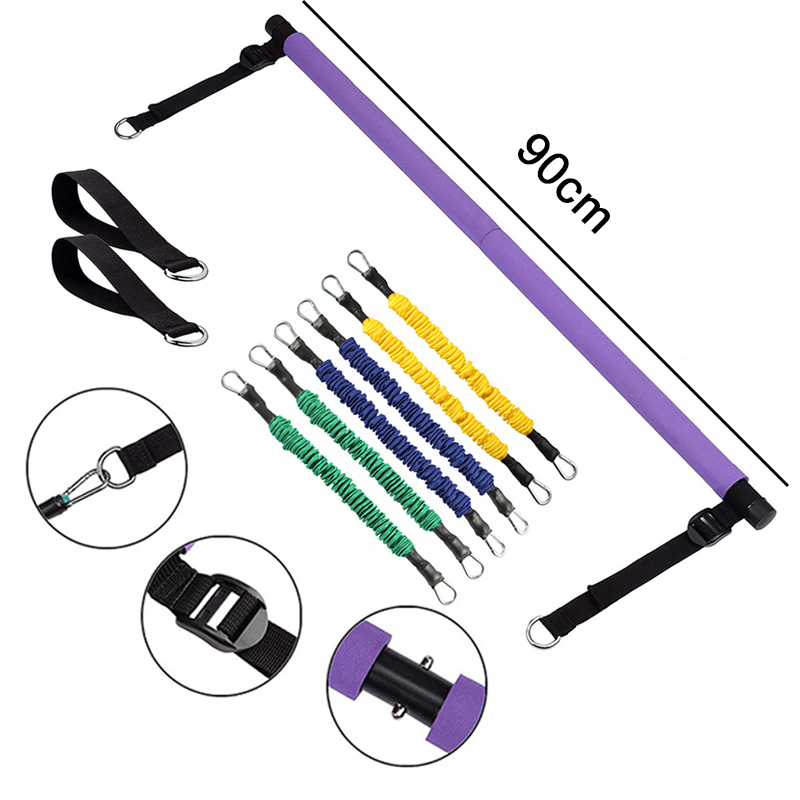
Placing the bar across the shoulders and the foot straps under the feet targets the gluteus maximus and hamstrings during hip extension. Integrating specific high-repetition lunge variations develops deep core stability and glute strength. Unilateral movements, such as split squats and curtsy lunges, require intense stabilization from the gluteus medius. The posterior chain is critical for athletic performance and daily functional movements. Weak glutes and hamstrings often lead to lower back pain and poor posture. Using the bar for exercises like good mornings and stiff-legged deadlifts directly targets these areas. The bands provide a unique challenge during the eccentric phase of these lifts. As you lower your torso, the bands try to pull you down faster. You must actively resist this pull, which heavily recruits the hamstrings and glutes to control the descent. This eccentric loading is highly effective for building strength and preventing hamstring injuries. During lunges, the uneven tension forces the core to work overtime to keep the torso upright, turning a standard leg exercise into a comprehensive core and lower body challenge.
Standard Squats: Place feet in straps, rest bar on shoulders. Drive through heels to stand.
Good Mornings: Bar on shoulders, hinge at the hips keeping legs relatively straight.
Reverse Lunges: One foot in strap, step back with the other leg, lowering knee to the floor.
Glute Kickbacks: On all fours, push one foot back against the strap resistance.
During the concentric phase of squats, the quadriceps drive the movement against the increasing tension of the exercise bands. The low-impact nature of band resistance reduces stress on the patellar tendon compared to heavy barbell squats, making it accessible and safe for users of any age. The quadriceps are responsible for extending the knee. When you perform a squat or a lunge with the bar, the quads must work hard to straighten the leg against the resistance of the tubes. Because the resistance increases as the leg straightens, the quads are forced to contract maximally at the top of the movement. This terminal knee extension is crucial for knee health and stability. It strengthens the vastus medialis oblique (VMO), the teardrop-shaped muscle just above the knee, which helps track the patella correctly. The smooth resistance curve of the bands also prevents the sudden spikes in force that can irritate the knee joint during heavy barbell lifting. This makes the bar an excellent tool for rehabilitation and for individuals with pre-existing knee issues.
Specific lateral movements, leg lifts, and leg presses isolate the adductor complex and abductors. These exercises mimic classic reformer footwork and the lifted seat barre exercises, effectively targeting the inner and outer thighs for balanced lower body strength. The adductors (inner thighs) and abductors (outer thighs) are often neglected in traditional strength training programs, which tend to focus heavily on sagittal plane movements like squats and lunges. However, these muscles are essential for lateral stability and pelvic alignment. Weak abductors can lead to knee valgus (knees caving in) during squats, which increases the risk of injury. Using the bar for lateral band walks or standing leg abductions directly targets the gluteus medius and minimus. Conversely, squeezing the legs together against resistance targets the adductors. This balanced development of the inner and outer thighs improves overall lower body mechanics and enhances athletic performance in sports that require lateral movement or rapid changes of direction.
Asymmetrical exercises force the core to resist rotation, heavily engaging the internal and external obliques. When you push or pull unevenly, your midsection must stabilize the spine, turning standard movements into intense core workouts. The core is not just about flexion and extension; its primary function is to stabilize the spine and transfer force between the upper and lower body. Anti-rotational exercises train the core to resist twisting forces, which is crucial for protecting the lower back during daily activities and sports. For example, if you perform a single-arm press with the bar, the resistance tries to twist your torso. Your obliques and transverse abdominis must fire aggressively to keep your shoulders square and your spine neutral. This type of training builds functional core strength that translates directly to improved performance and reduced injury risk. It also develops the obliques more effectively than traditional crunches or sit-ups.
Pilates-specific movements, like the Teaser, seated roll-downs, or bicycle crunches with foot straps, isolate the deep abdominal wall. The bar assists in targeting the transverse abdominis rather than just the superficial rectus abdominis, promoting true core strength. The transverse abdominis acts like a natural weight belt, wrapping around the torso to compress the abdominal contents and stabilize the spine. Traditional ab exercises often neglect this deep muscle in favor of the more visible rectus abdominis (the six-pack muscle). However, a strong transverse abdominis is essential for a flat stomach and a healthy lower back. Using the bar for exercises like the Pilates roll-up forces you to articulate the spine segment by segment, which requires intense control from the deep core muscles. The resistance of the bands also provides feedback, helping you to feel when you are losing core engagement and relying on momentum or hip flexors instead.
Working against the upward pull of the bands requires strict pelvic stability. This promotes better pelvic floor engagement and spinal decompression, crucial for maintaining long-term postural health and preventing lower back pain. The pelvic floor muscles work in tandem with the deep core to support the internal organs and stabilize the pelvis. When you perform exercises with the bar, especially those that involve standing or balancing, you must actively engage the pelvic floor to maintain proper alignment. This co-contraction of the pelvic floor and the transverse abdominis creates a solid foundation for movement. Furthermore, the upward pull of the bands during exercises like overhead presses can actually help to decompress the spine, counteracting the compressive forces of gravity and prolonged sitting. This decompression relieves pressure on the intervertebral discs and promotes a taller, more upright posture.
Rowing and pulling variations target the rhomboids, latissimus dorsi, and posterior deltoids. These movements counteract forward-head posture, acting as a Posture Tonic by strengthening the muscles responsible for pulling the shoulders back and down. Modern lifestyles involve significant time spent hunched over desks and screens, leading to weak upper back muscles and tight chest muscles. This imbalance pulls the shoulders forward and rounds the upper back. The bar is an excellent tool for correcting this issue. Exercises like bent-over rows, face pulls, and reverse flyes specifically target the muscles that retract and depress the scapulae. The continuous tension of the bands forces these muscles to work throughout the entire range of motion, building the endurance necessary to maintain proper posture throughout the day. Strengthening the posterior deltoids also improves shoulder joint stability and reduces the risk of impingement syndromes.
Bent-Over Rows: Hinge at hips, pull bar to stomach, squeezing shoulder blades together.
Upright Rows: Stand tall, pull bar up to chest level, leading with the elbows.
Face Pulls: Attach bands to a high anchor, pull bar towards face, separating hands.
Lat Pulldowns: Sit on floor, bands anchored high, pull bar down to upper chest.
The engagement of the biceps brachii during curls and the triceps brachii during overhead extensions is highly effective. The rigid bar ensures even bilateral tension, preventing your dominant arm from compensating for the weaker one, leading to balanced arm development. When using dumbbells, it is common for the stronger arm to do more work, leading to muscle imbalances. The solid structure of the bar forces both arms to work equally to move the resistance. This bilateral symmetry is crucial for balanced strength and aesthetics. For the biceps, the variable resistance of the tubes means the peak contraction at the top of the curl is intense, maximizing muscle fiber recruitment. For the triceps, exercises like overhead extensions and skull crushers benefit from the constant tension, which keeps the muscle engaged even when the arm is fully extended. This continuous engagement leads to greater metabolic stress and muscle fatigue, driving adaptation and growth.
Overhead presses, front raises, and lateral raises activate the anterior and medial deltoids. The safety profile of the tubes is excellent for the rotator cuff, providing smooth resistance that builds strength without the high injury risk associated with heavy overhead free weights. The shoulder is a highly mobile but relatively unstable joint, making it susceptible to injury. Heavy barbell presses can lock the shoulders into unnatural movement patterns, increasing the risk of impingement or rotator cuff tears. The bands allow for a more natural range of motion, accommodating the individual biomechanics of your shoulder joints. The variable resistance also means the load is lightest at the bottom of the movement, where the shoulder is most vulnerable, and heaviest at the top, where the joint is most stable. This strength curve is ideal for safely developing the deltoids and the stabilizing muscles of the rotator cuff.
The ideal user profile includes individuals focused on muscular endurance, mobility, active rehabilitation, low-impact joint-friendly workouts, and hyper-convenient home training. It is perfect for those who want a versatile tool without dedicating significant space. If your primary goal is to build massive muscle size or compete in powerlifting, this equipment will not replace heavy barbells and squat racks. However, if you want to improve functional strength, correct postural imbalances, increase flexibility, and maintain a consistent fitness routine without leaving your house, the bar is highly effective. It is particularly beneficial for older adults or those recovering from injuries, as the smooth resistance curve minimizes joint stress. It also appeals to frequent travelers, as the bar can usually be disassembled and packed into a suitcase, allowing you to maintain your workout routine anywhere.
Can a pilate bar replace a traditional gym footprint? Yes, for many users. Key movements translate perfectly to the bar-and-band setup, offering a comprehensive routine. You can perform variations of almost every major compound lift. While the absolute load will be lower than what you can achieve with iron plates, the continuous tension and the ability to perform high-repetition sets provide a potent stimulus for muscle conditioning and fat loss. The key to replacing a gym workout is exercise selection and intensity. By focusing on compound movements and minimizing rest periods, you can create a highly demanding metabolic conditioning workout that rivals the intensity of a traditional gym session.
Traditional Gym Exercise | Pilate Bar Equivalent | Primary Muscle Group |
|---|---|---|
Barbell Back Squat | Band Resisted Squat | Quadriceps, Glutes |
Romanian Deadlift | Band Resisted Good Morning | Hamstrings, Lower Back |
Cable Row | Bent-Over Band Row | Latissimus Dorsi, Rhomboids |
Dumbbell Overhead Press | Standing Overhead Band Press | Deltoids, Triceps |
Cable Crunch | Resisted Roll-Downs | Rectus Abdominis, Core |
The primary limitation is the finite resistance of standard tubes. To accommodate strength gains over time, purchase models with interchangeable or stackable bands. This allows you to increase the tension as your fitness level improves. Progressive overload is the fundamental principle of muscle growth and strength development. You must continually challenge your muscles with greater demands to force adaptation. With free weights, you simply add more plates. With bands, you must either use thicker tubes, combine multiple tubes, or alter the mechanical advantage. You can increase tension by wrapping the bands around the bar, widening your stance, or pausing at the point of peak contraction. However, there is a limit to how much tension you can safely apply before the bands become unwieldy or the risk of snapping increases. Therefore, selecting a high-quality bar that supports multiple heavy-duty bands is crucial for long-term progression.
The rigid bar offers ergonomic benefits, allowing for barbell-style grips, structured leverage, and better wrist alignment. This is often superior to the loose versatility of standalone loop bands, especially for compound lifts. Standalone bands are excellent for isolation exercises and mobility work, but they can be awkward to hold during heavy compound movements like squats or presses. The bands can dig into your hands or roll up your arms, causing discomfort and distracting from the exercise. The bar provides a solid, comfortable grip that mimics the feel of a traditional barbell. This allows you to apply more force and maintain better form. The bar also acts as a lever, allowing you to perform asymmetrical exercises and rotational movements that are difficult or impossible with standalone bands. The structured grip ensures that your wrists remain in a neutral position, reducing the risk of strain or injury.
There is a risk of tube snapping, band degradation, or carabiner failure. Evaluate build quality carefully. Look for steel core bars, protective nylon sleeves over latex tubes, and heavy-duty metal clips to ensure safety during intense workouts. Resistance bands degrade over time due to exposure to oxygen, UV light, and repeated stretching. A snapped band can cause severe injury, especially if it strikes the face or eyes. To mitigate this risk, always inspect your bands for micro-tears, discoloration, or brittle spots before every workout. Replace them immediately if you notice any signs of wear. Purchasing bands with protective nylon sleeves adds a layer of safety; if the latex snaps, the sleeve contains the recoil. The connection points are also critical failure zones. Avoid cheap plastic clips. Ensure the carabiners and D-rings are made of solid steel and are securely stitched into the webbing. The bar itself should have a thick steel core to prevent bending or snapping under heavy loads.
Improper tension can occur if the user is too tall or too short for the standard band length. Mitigation tactics include wrapping the bands around the bar to increase tension, utilizing adjustable webbing straps, or widening your stance to customize the resistance. If you are very tall, standard bands may stretch too far, increasing the risk of snapping and altering the resistance curve. If you are short, the bands may be slack at the beginning of the movement, reducing the effectiveness of the exercise. Adjustable straps allow you to lengthen or shorten the connection point, ensuring optimal tension regardless of your height. Proper form is also essential. Because the resistance increases at the end of the range of motion, there is a tendency to cheat by using momentum or altering your body mechanics to complete the rep. Focus on slow, controlled movements, and prioritize strict form over the amount of tension used.
Assess your current home gym setup and identify your primary fitness goals to determine if variable resistance training aligns with your needs.
Review top-rated models that feature adjustable resistance, steel construction, and high-quality latex or fabric-wrapped tubes to ensure safety and durability.
Implement a structured routine focusing on compound movements like squats, rows, and presses to maximize the metabolic and muscular benefits of the equipment.
Regularly inspect your resistance tubes and connection points for wear and tear to prevent equipment failure and potential injury.
A: Yes, for muscular endurance and toning. A suite of key compound exercises can mimic a full-body gym routine, though it may not replace heavy strength training for maximal hypertrophy.
A: Toning is muscle growth combined with fat loss. While it builds foundational muscle and endurance, the hypertrophy limits of resistance tubes mean it will not build massive muscle like heavy weights.
A: A pilate bar is portable, band-based resistance equipment. A Pilates barre is a stationary ballet-style handrail used in studios for balance and isometric holds.
A: Yes, resistance training elevates your metabolic rate. However, effective weight loss always requires maintaining a caloric deficit alongside your workout routine.
A: You can adjust resistance by rolling the band around the bar, widening your stance, or swapping out interchangeable exercise bands for higher tension levels.
A: Yes, the low-impact nature of variable resistance makes it highly suitable for beginners and rehabilitation, though medical clearance is always recommended first.
